Laura Albajar

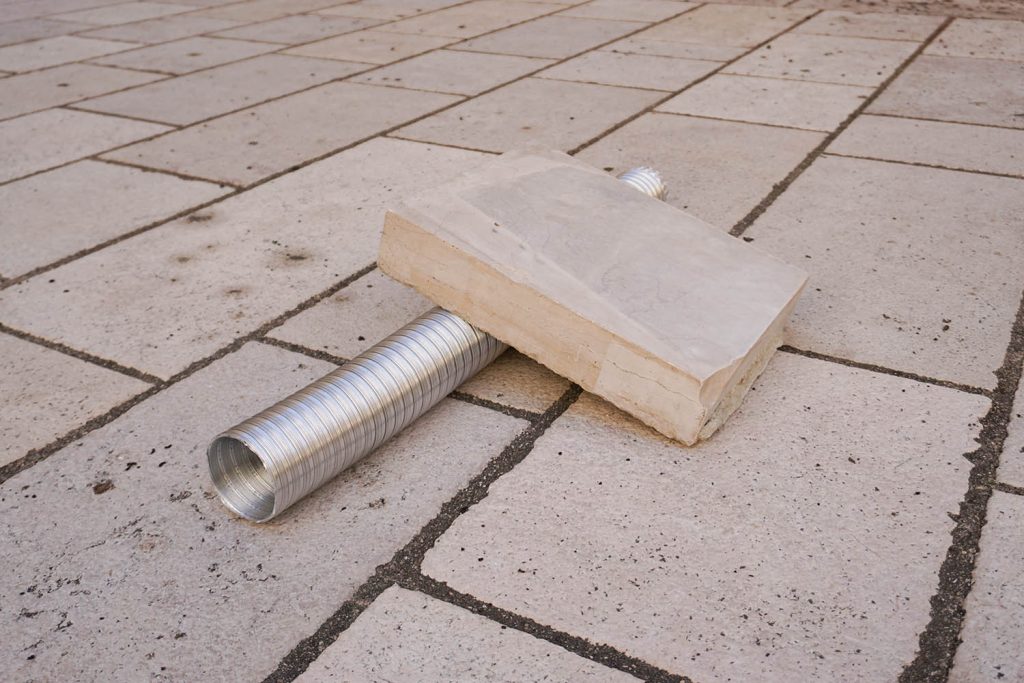
The artist Laura Albajar has completed an artistic residency at Ramdom (Castrignano dei Greci, Italy) through our Exchange programme, during September and October 2025. There, she presented the following work:
Tube, tubing, tubeity
Laura Albajar’s practice begins with a quiet attentiveness to the infrastructures that sustain, connect, and regulate the visible world. During her residency in Castrignano de’ Greci, she focused on the presence of the tube—an element of passage that usually hides within walls, roofs, and corners.
In Correccions cromàtiques, she decided to repaint the town’s tubes in the same beige tone as the Leccese stone, bringing them into visual harmony with their surroundings and softening the industrial colours that had previously stood out against the landscape. The action was simple yet intentional: a chromatic correction that blurred the boundaries between what belongs and what intrudes, between maintenance and intervention. Dressed as a worker to blend into the environment, the artist performed an act of camouflage—an act of working through disappearance—that traces how subtle adjustments can shift the perception of space.
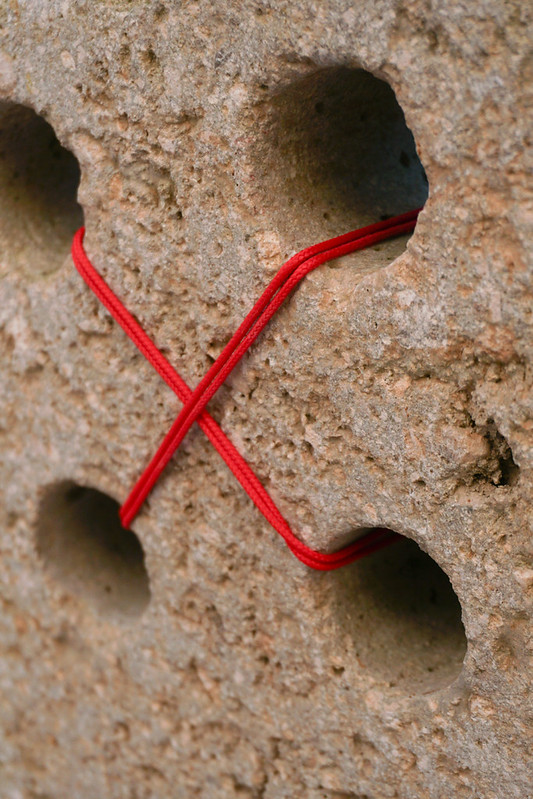
Inside the historic Palazzo Baronale, this investigation takes on a spatial form in the installation Entre el que pesa i el que passa. Metal tubes, red threads, and fragments of Leccese stone create a system of connections and tensions that infiltrates the architecture itself. The installation explores how matter negotiates with air, how the fixed and the mobile coexist, and how tradition—embodied by the stone—interacts with the presence of new industrial materials.
In this sense, tube, tubing, tubeity can be read as a meditation on correction, adaptation, and visibility. Through minimal gestures, Albajar draws attention to the balance between adjustment and disruption, suggesting that even the smallest acts of alignment can transform the way we relate to the built environment around us.
Laura Albajar (Barcelona, 2001) graduated in Fine Arts from the University of Barcelona and a Master’s in Art Direction and Scenic Space Design from BAU, Centre Universitari d’Arts i Disseny. Her practice is site-specific and material-based, exploring expanded painting, spatial dialogue, and minimal gestures that activate relationships between space, perception, and everyday infrastructures. In 2025 she completed a residency at Lo Niu, awarded by Fundació Guillem Viladot, and took part in the group exhibition Tot tombant, convoco at Lo Pardal. She received the XVII Felícia Fuster Grant for Young Visual Artists (2024), which resulted in the group exhibition Construir, habitar, pensar, exhibir i mirar at Fundació Felícia Fuster (2024), and also participated in the group show Meeting Point (2024) at the same foundation. Her work has been exhibited in Sense Títol ’23 at the Faculty of Fine Arts, University of Barcelona (2023).



Collaborating: Institut Ramon Llull and Ramdom.